Donald Rumsfeld made famous the expression ‘unknown-unknowns’ on the 12 Feb 2002
(see for example: https://en.wikipedia.org/wiki/There_are_unknown_unknowns ). The US Secretary of Defense, Donald Rumsfeld, was providing an answer to a question at a Department of Defense briefing on weapons of mass destruction. But how do we deal with unknown-unknowns in our everyday lives, both practically and emotionally? And why does it matter?
How we deal with any type of unknown has far reaching ramifications for how we feel, how we behave, how we act and subsequently how we affect the world around us. Uncertainty can lead directly to stress, which if unchecked leads to physiological and psychological harm (Peters, McEwan and Friston, Progress in Neurobiology, 156 (2017)) and potentially physical harm.
If we lack the skills to deal with the uncertainty of the unknown, we could easily allow the situation we are in to take on an uncontrolled life of its own, leading to undesirable outcomes, specifically ‘allostatic load’, and the consequential effects upon our well-being.
Interestingly, the term ‘stress’ was coined relatively recently in 1936, somewhat aligned with the world that humans inhabit becoming more complex and uncertain, quite different from a world in which humans were designed to thrive. As successful hunter-gatherers, humans encountered challenges that they could alleviate quickly preventing chronic stress arising from persistent concerning unknowns. Today, our world has become volatile, uncertain, complex and ambiguous (see for example: https://hbr.org/2014/01/what-vuca-really-means-for-you ).
Because the brain is designed to primarily focus of ensuring safety, it has executive powers to use as much energy as it needs to process uncertain situations and activates the sympathetic nervous system at the same time – that is the basic fight/flight/freeze response. In so doing, logical thinking and sound decision making can be impaired and physiological damage to the body follows. This reaction happens in all humans when faced with uncertainty, some of us to a greater or lesser extent.
Besides the functional benefits of being better able to manage outcomes, we will also be happier and healthier as well if we have a mechanism for dealing with the uncertainty of the unknown. If we can manage feelings of uncertainty, we can control anxiety and our brain and body chemistry moves away from a state of inflammation (see for example https://en.wikipedia.org/wiki/Ed_Bullmore and The Inflamed Mind).
There are many things that stress humans and trigger physiological and psychological effects. Our stress system (the sympathetic nervous system) can be triggered by a bacterial infection, or a loud noise, a frightening sight or even a terrifying thought (see for example https://www.sciencedirect.com/science/article/pii/S0301008217300369 ). Uncertainty is a pernicious root cause of human stress, which needs to be managed if optimum human cognitive (and physical) performance is to be achieved.
Stress has been shown to affect gene expression and damage DNA (see the work of Elizabeth Blackburn in Telomere Effect (2016)). Acute and chronic stress interferes with cognition, decision making, mood, the immune system (see the work of Edward Bullmore in The Inflamed Mind (2018)), metabolic function leading to multi-morbidity. Eliminating anxiety caused by uncertainty is essential.
Some of us are psychologically pre-disposed to cope with the unknown better than others but we can all learn to better manage our relationship with the unknown and thereby have more control over the outcomes available to us.
Stress comes in three varieties:
Good stress – this is time limited and helps to motivate us to regain certainty or learn a new competence to quickly reduce the stress
Tolerable stress – this is limited in time or severity and can be accommodated by allowing the stress to be habituated (that is the stress is reduced naturally as we get used to it)
Toxic stress – this is stress we are unable to escape and continues for a long time untreated leading to allostasis load and ill health. It is this stress that needs to be identified and eliminated.
So how do we go about managing uncertainty and controlling the potential stress by analysing unknowns in a structured manner?
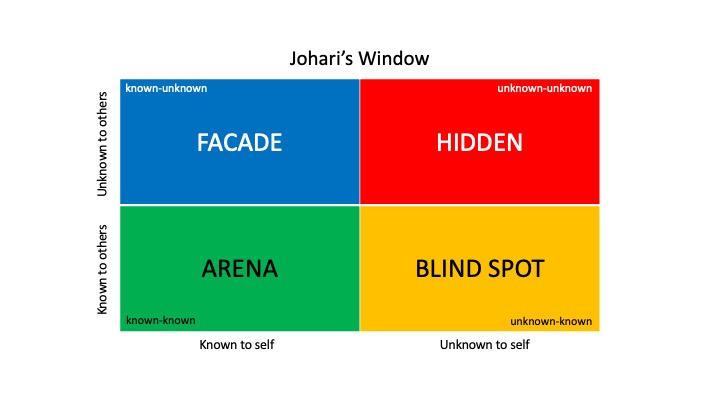
Since the 1950’s a systematic way of looking at the world was considered by two American psychologists, Joseph Luft and Harrington Ingham in their development of the Johari window. We may be more familiar with the Johari Window from management training courses than the manifestation used by Donald Rumsfeld in 2002. Although they are similar, the Johari window is simpler to understand, being applied to a specific situation, namely an individual person and their knowledge sharing with self and others.
The Johari Window is an analytical approach to exploring ones personality in the context of peers (how we experience ourselves versus how other experience us). It can be used in a number of different ways to build self-awareness or manage group dynamics.
Essentially, it is a way for us to learn something about our blind spots (the things we do not know about ourselves but are known by others, our unknown-knowns) to increase our self-awareness and thereby build better interfaces with others. We can then explore our façade (the things we know but others do not, our known-unknows) to help increase our openness. We can investigate those aspects of ourselves that we choose to share and others are fully aware of, our so-called arena (things we and others know, our known-knowns). And finally, there are the things that we do not know about ourselves and others do not know about us either (our unknown-unknowns), where we can work with peers to explore what these might be by inference from the collectively known information. The Johari Window helps us experience a more mature view of ourselves with the assistance of our peers to build trust and thereby collective performance. It helps us recognise and experience reality, rather than a personal biased view of ourselves. Armed with the realistic information about ourselves it is more likely that relationships can be matured and positive, meaningful, change can be instigated.
But what about an even more complex situation with more dimensions of interaction, involving people, processes, information and technical components, such as a project or a programme. How do we deal with the uncertainty in that kind of unbounded situation?
Expanding the Johari Window concept beyond being focussed on self-awareness we can consider in detail the more systemic framework made famous by Donald Rumsfeld.
In total there are logically four combinations of the concept of ‘unknown’ and ‘known’, in much the same way as there are in the Johari Window. In the Rumsfled model the unknowns and knowns relate to system information rather than self-information. The terms relate to an attribute being known or unknown and the data associated with that attribute being known or unknown. It is interested in the absolute information about the systems rather than the relative information about the self, which is the focus in the Johari Model. Correspondingly, the Rumsfeld Model leads to a richer analysis model with more cognitive challenges.
Often only three combinations: unknown-unknown, known-unknowns and known-knowns, are discussed, following the particular Rumsfeld answer in 2002. The unknown-known seems to have been discussed at a later time by Rumsfeld (see for example https://www.youtube.com/watch?v=9TcZ2-sEb3o ).
To understand the value of the Rumsfeld Framework it is helpful to look at the four combinations in a very simple case and see why the fourth combination is less used but nonetheless possibly more interesting.
Let’s think about a work colleague.
Maybe we know the work colleague to a certain extent. Consider what we do and do not know about our colleague.
We might ask “what is her name?” Maybe her name is Joan and we know this because we have already asked her. This is a known-known i.e. we know our work colleague has a name (attribute) and we know her name (data).
We know that Joan must have a date of birth (attribute) but we do not normally know (data) this type of information. But the information is knowable. This is a known-unknown i.e. it is information that is available but we do not know it. If we wanted to know Joan’s date of birth we could ask her. If she shared the information (given it is a known-known for her) then we would have another known-known for us. By asking a question there is a possibility the known-unknown can migrate to become a known-known.
We might ask when Joan will die. We know this is going to happen (attribute) but nobody knows when Joan will die (data). Here is a second type of known-unknown but here the information is unknowable and we have no way of turning this attribute into a known-known, at least until time passes and the event occurs.
If we notice that Joan is upset (attribute) we may not know why (data). We know the answer to a question but we do not know the question. Here we have an unknown-known. If we wish to resolve the uncertainty we could in principle simply ask Joan “I can see you are upset but why are you upset?”. If Joan knows the answer she may be willing to share the information leading to another known-known for us.
This combination of ‘knowns’ and ‘unknowns’ is often overlooked but was later discussed by Donald Rumsfeld in a 2014 documentary. In that documentary Rumsfeld defines the unknown-known as being information you think you know but actually you do not. However, this interpretation by Rumsfeld is not consistent with the model framework. If we think that Joan was called Jean then our known-known would simply be wrong. A more consistent interpretation of the unknown-known would be where we know information but have not realised that it has a relevant significance.
Perhaps we know the local MP is helpful and effective (data) but we have not realised that the MP (attribute) is Joan. If we ask questions about unknown-known situations we will be able to create further known-knowns and reduce our uncertainty.
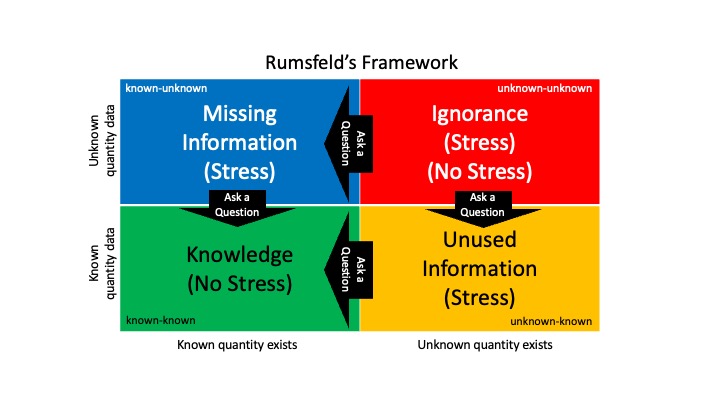
The combination that Donald Rumsfled popularised is the unknown-unknown.
This situation is more complicated and it is often challenging to reduce associated levels of uncertainty. In all of the other cases we were able to simply ask questions to see if a known-known could be generated. Here that approach does not work straightforwardly.
To reduce our uncertainty, maybe we could randomly pick a topic that we have never considered before. This would be an unknown-unknown. We could ask “is Joan a spy (attribute)?”. As soon as we formulate the question it ceases to be an unknown-unknown and becomes a known-unknown. This approach could lead to a large number of known-unknowns, some might be reduced to known-knowns but many may not be. Further uncertainty and stress may result.
So what is an unknown-unknown and how do we deal with such unbounded, and potentially stressful, uncertainty?
One way of illuminating unknown-unknowns is to employ techniques such as a ‘Pre-Morten Exercise’ (see for example https://hbr.org/2007/09/performing-a-project-premortem ). By looking forward to a future time and inventing a disastrous outcome for a project or a personal situation, it is possible to explore what the sequence of events might be that could lead to bad outcomes and thereby discover unknown-unknowns. Using this structured technique limits the number of possibly infinite unknown-unknowns to scenario specific considerations.
One issue with the Pre-Mortem Exercise is it is limited to the envelope of our existing imagination and is not robust to exploring completely unexpected events so we need a more generic way of dealing with unknown-unknows.
Insulating ourselves against the stress associated with not knowing the future is best achieved by supplementing standard management techniques (like the pre-morten technique as well as others such as multi-criteria decision analysis etc.) with a particular mental attitude or way of being. It is the way in which we respond to uncertainty that is the most effective way of dealing with it.
Controlling the fear response of fight/flight/freeze is critical to building the personal resilience needed to deal with uncertainty, reducing the bodies allostatic load and increasing performance.
There are three ways in which we can helpfully respond to uncertainty:
- Actively seek more information, directly reducing the uncertainty.
- Learning through experience to trust certain information more than other information, reducing the surprise when something unexpected happens.
- Habituation to normalise the uncertainty, realising and becoming comfortable with uncertainty and accepting it is a natural consequence of life.
Actively seeking more information is the first step. Learning which information is more reliable and becoming comfortable with uncertainty follow in time with effort. Let us focus just on actively seeking more information.
How do we actively seek more information with ease?
Simply asking a question is not that simple.
An attitude of curiosity can help facilitate the willingness to ask exploratory questions about the scenario of interest. Often, answers can be illuminating even if we thought we knew the subject matter, simply because all information can never be known, regardless of how much effort is expended. But occasionally an answer can be given that leads to further questions that results in surprising conclusions. An unknown-unknown will have been discovered which can then be turned into a known-unknown allowing further treatment to be applied.
Having a curious attitude or way of being is actually not as easy as it sounds. Curiosity needs the courage to ask difficult questions to overcome the fear that offence may be caused and a difficult situation results. Some people are comfortable with difficult situations whereas others are not (see for example https://www.insights.com/products/insights-discovery/ where red personality types would be more comfortable and green personality types would be less comfortable creating difficult situations). Different levels of courage thus need to be applied by different types of people to ask probing questions. Everybody can benefit from training to understand the nature of fear and the attribute of courage, which means managing the fear response of the body, not switching it off.
Curiosity needs to be guided into areas that are most fruitful to uncover relevant unknown-unknowns. Random curiosity can quickly lead to distraction from the main concern. Open, honest conversations about concerns and lack of knowledge catalyse appropriate and meaningful discussions. But to do that successfully and repeatedly it is necessary to have an environment that is conducive to difficult conversations, where we may feel vulnerable. Establishing a psychologically safe place to have exploratory conversations is a necessary prerequisite to allow the number of on-going conversations needed to find the unknown-unknowns. Without it discussions will become limited and defensive.
Creating a psychologically safe environment is challenging for everybody. Individuals need to be able to feel safe and be safe and that arises if everybody can behave in a manner that does not cause anxiety for any of the other community members, otherwise information held by them will not be shared. Building a psychologically safe environment in which information can flow freely is non-trivial. All participants need to be self-aware, to know how their behaviour style can affect others, and self-controlled to be able to regulate their reactions to other individuals’ behaviour. Psychometric profiling can be an effective way to build mutual self-awareness within the community.
This works well when the community is bounded, such as in a team or a business. Generally, it is not possible to measure and share psychometric profiles of all people who could be a catalyst to finding unknown-unknowns. In general, it is only possible to manage our own reactions and behaviours in a manner that is helpful to others so that they feel comfortable to interact with us, and share information.
Staying aware of our behaviours and reactions as they are happening allows immediate changes to be made as the line of questioning driven by curiosity evolves. Responding (taking time to think before taking action) and not reacting (taking action instinctively without thinking if it is appropriate) to the information discovered is essential to maintain open communications. Looking for unknown-unknowns may not always lead to information that is desirable, potentially catalysing a negative feeling.
Being able to accept negative feelings without reacting demands a level of resilience that can be achieved by developing a skill in mindfulness. In its simplest form, mindfulness allows the mind to be aware of the negative feeling for long enough to avoid an unhelpful reaction thereby preserving the communication channel and minimising anxiety. Mindfulness is an extension of self-awareness that allows us to control our reaction dynamically.
As soon as we learn how to manage our feelings and emotions we become more in tune with the reality of the situation, more capable to find hidden aspects of the reality and less anxious about the unknown. Taking action at the personal level and at the technical level helps to assure helpful outcomes and lowers stress and inflammation in the body. Projects and people become healthier at the same time.
Taking a ‘systems-of-systems’ view of project delivery leads to the realisation that the common component in all projects is the human. Once this is realised it becomes more straightforward to work out how to optimise project delivery by managing how humans deal with uncertainty. Building technical skills, such as asking questions, and cognitive skills, such as mindfulness, are the fundamentals of optimising project performance.
Actively seeking more information to reduce uncertainty requires:
- Curiosity – which needs bravery (to ask the right questions)
- Mindfulness – which needs perseverance (to listen to the right answer)
- Psychological safety – which needs self-regulation (to communicate with the right people)
The reality of the world around us is that it is uncertain. There is nothing we can do to fully control the uncertainty. We need to accept it and not get stressed by it. What we can do is control how we respond to uncertainty. By managing our response we can remain in a low stress state, maintain awareness and make better decisions that help to minimise negative outcomes. Project delivery is enhanced while psychological, physiological, and potentially physical damage is diminished.